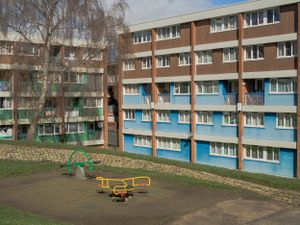
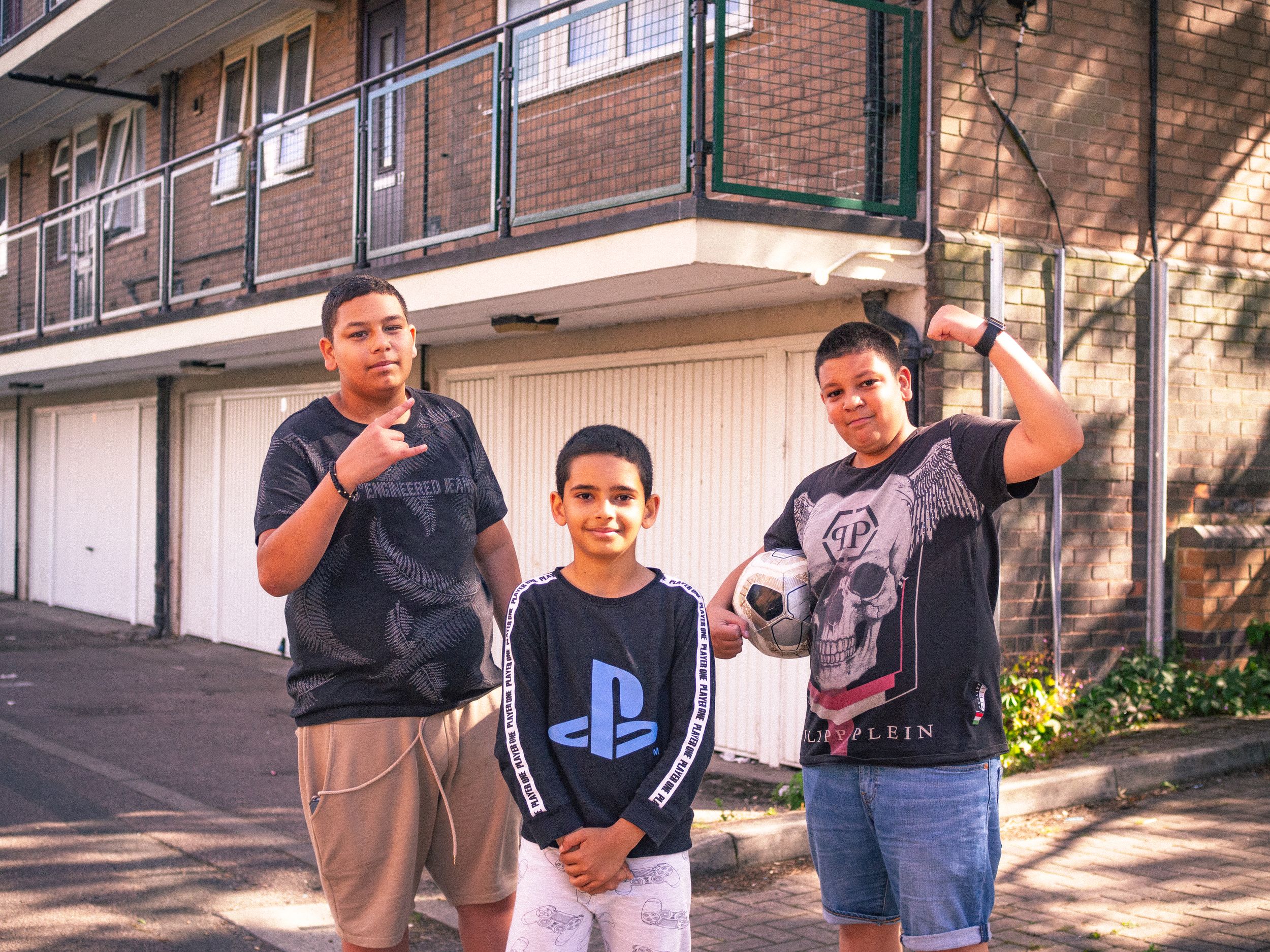
Capturing a 'Post-Industrial' City:
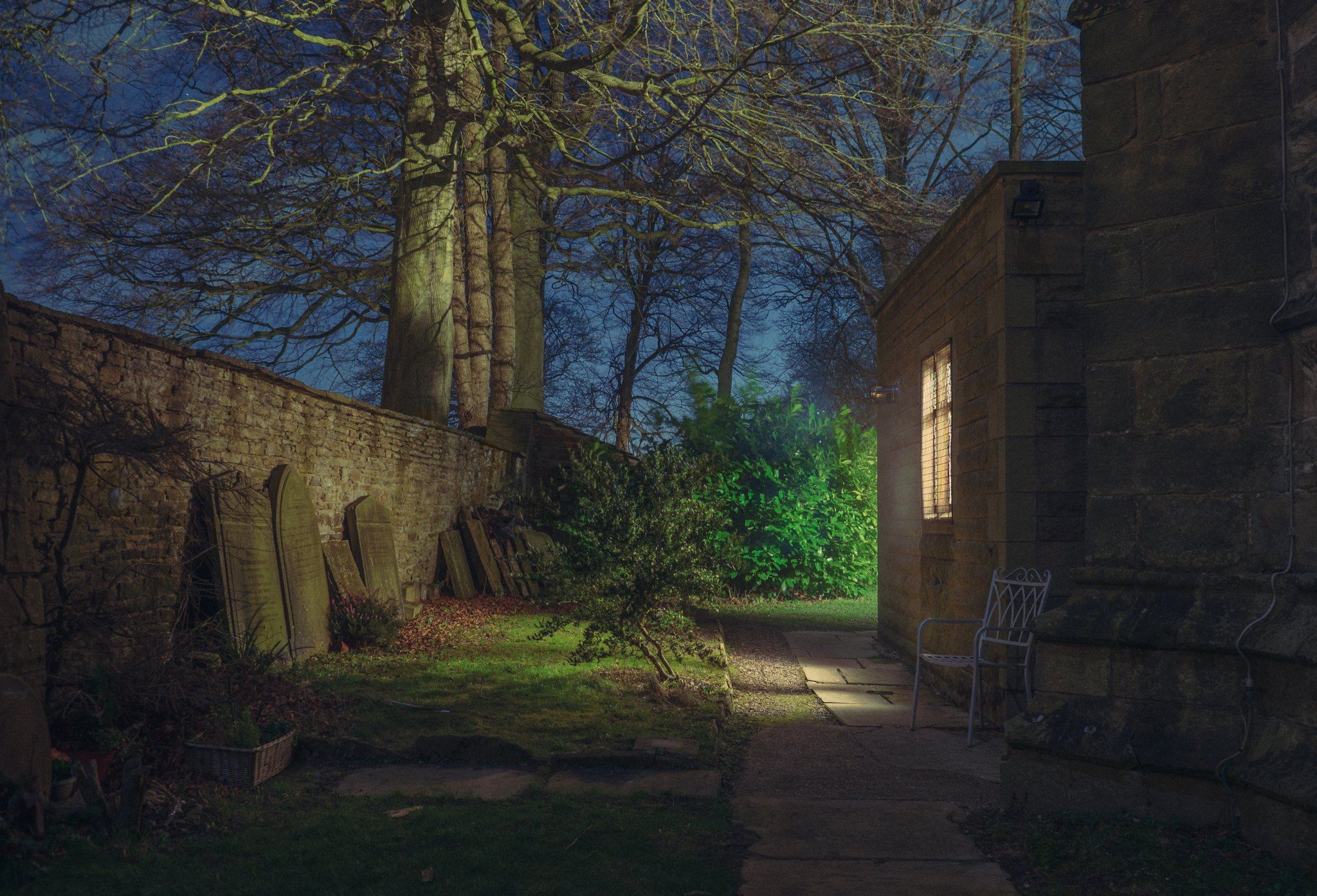
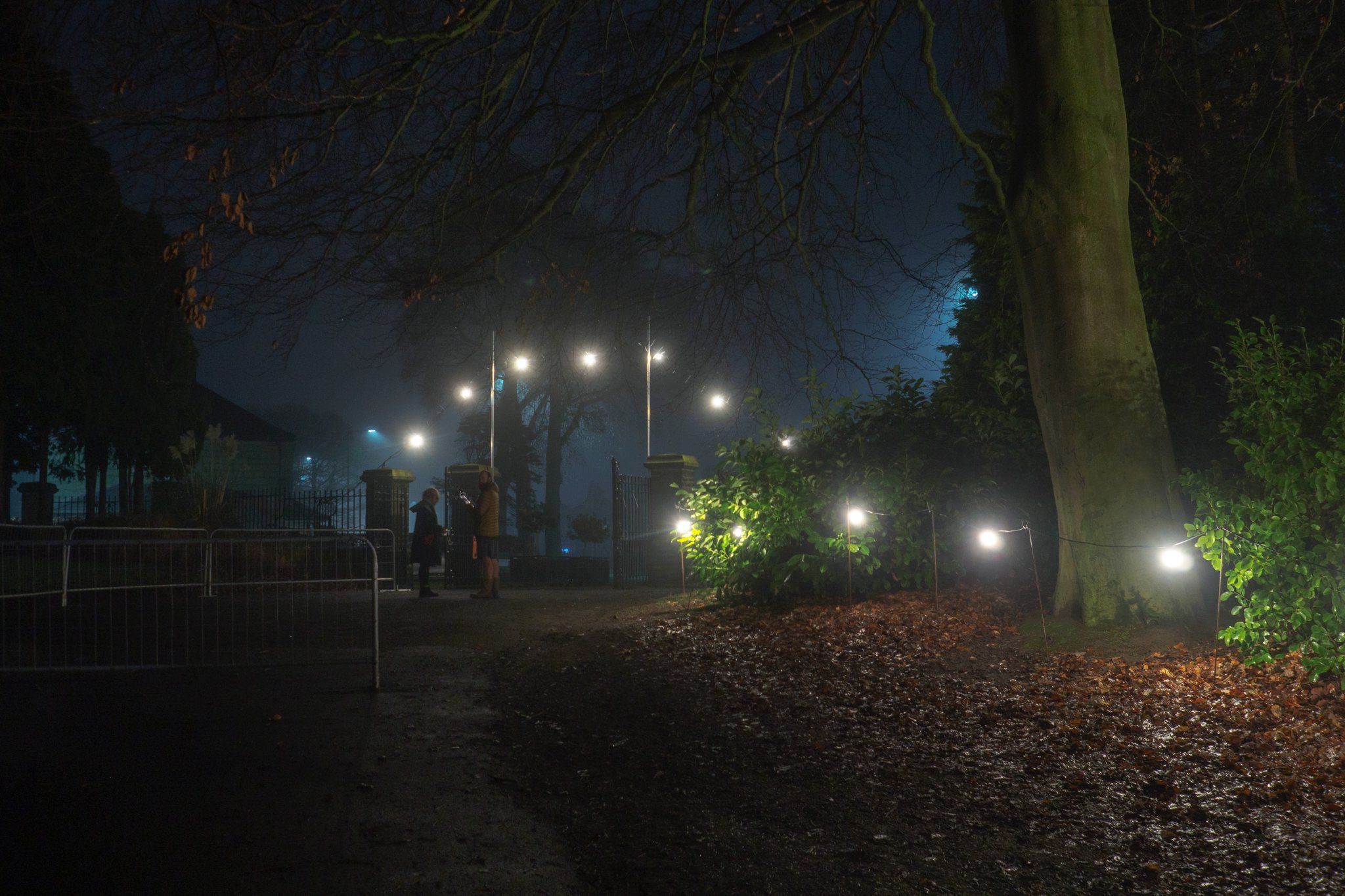
Practice & Process
Gallery A
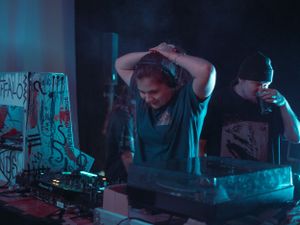
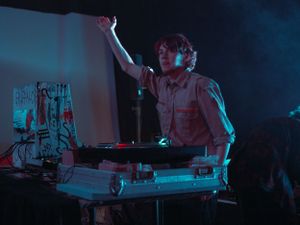
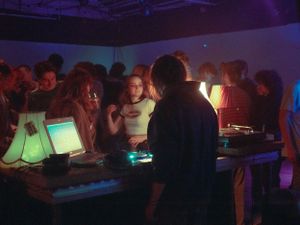
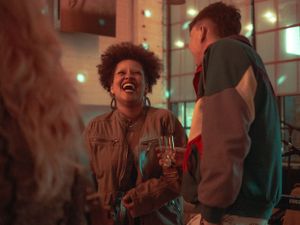
A Critical Analysis of my work & methods
The following writing is a reflection upon my own practice & process, as part of my work towards an ongoing Masters in Creative Practice. The passage will be split into two parts, the first being a Prototype which displays the production methods, drafting, and prototyping techniques used within my creative process.
The second passage, a Production Diary, will represent a deeper reflection which considers the sustainability of my methods, the success of my collaborations, and the relation between my work and its audience.
A large portion of this reflection will focus upon an earlier project, the production of a script for a short film, which I made the decision to move on from. As such, this reflection upon the challenges I faced - and the steps I had to take to overcome them - may not be directly linked to the practice of photography , but it will provide valuable insight into my creative process and an opportunity for me to develop from my experiences.
Prototype
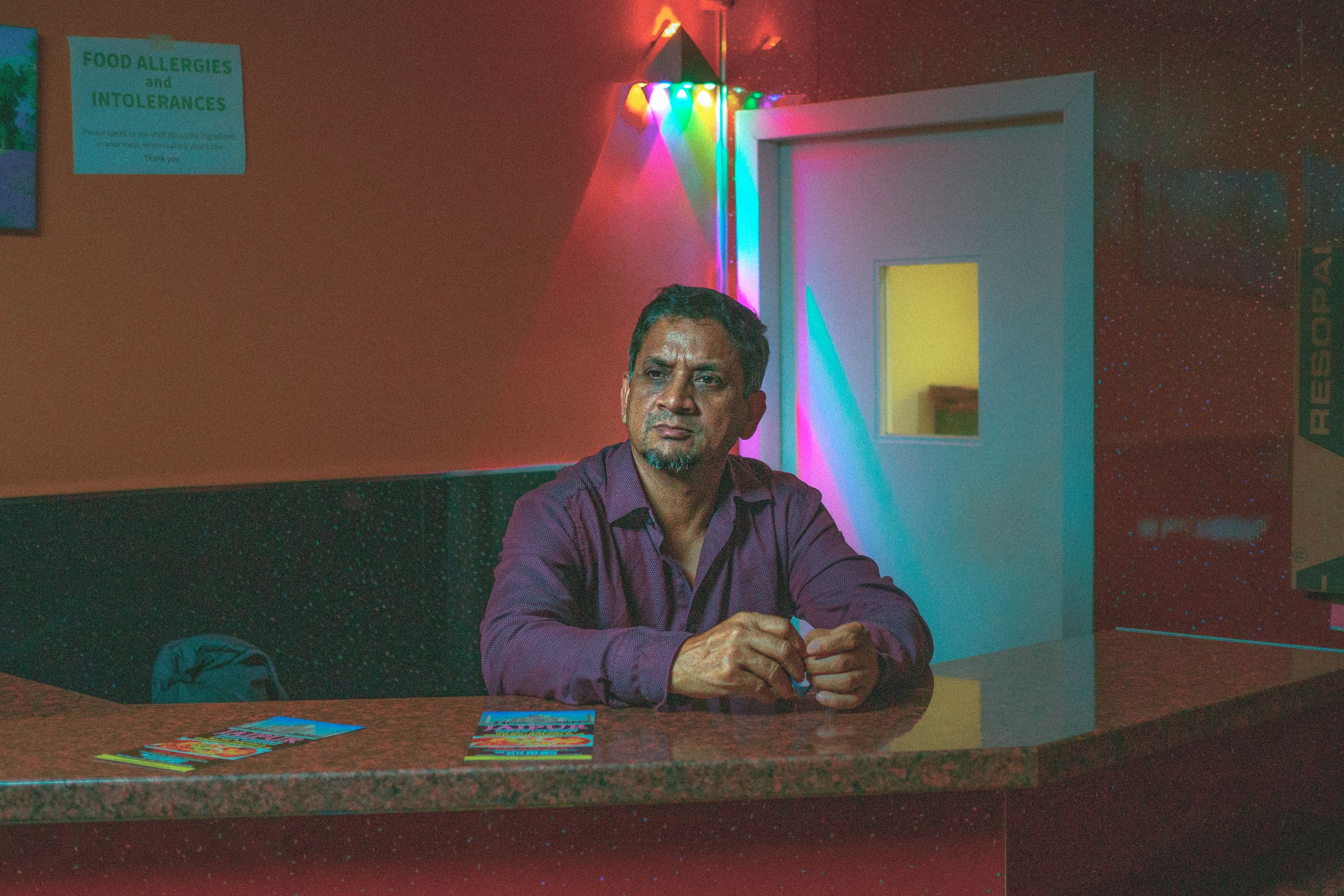
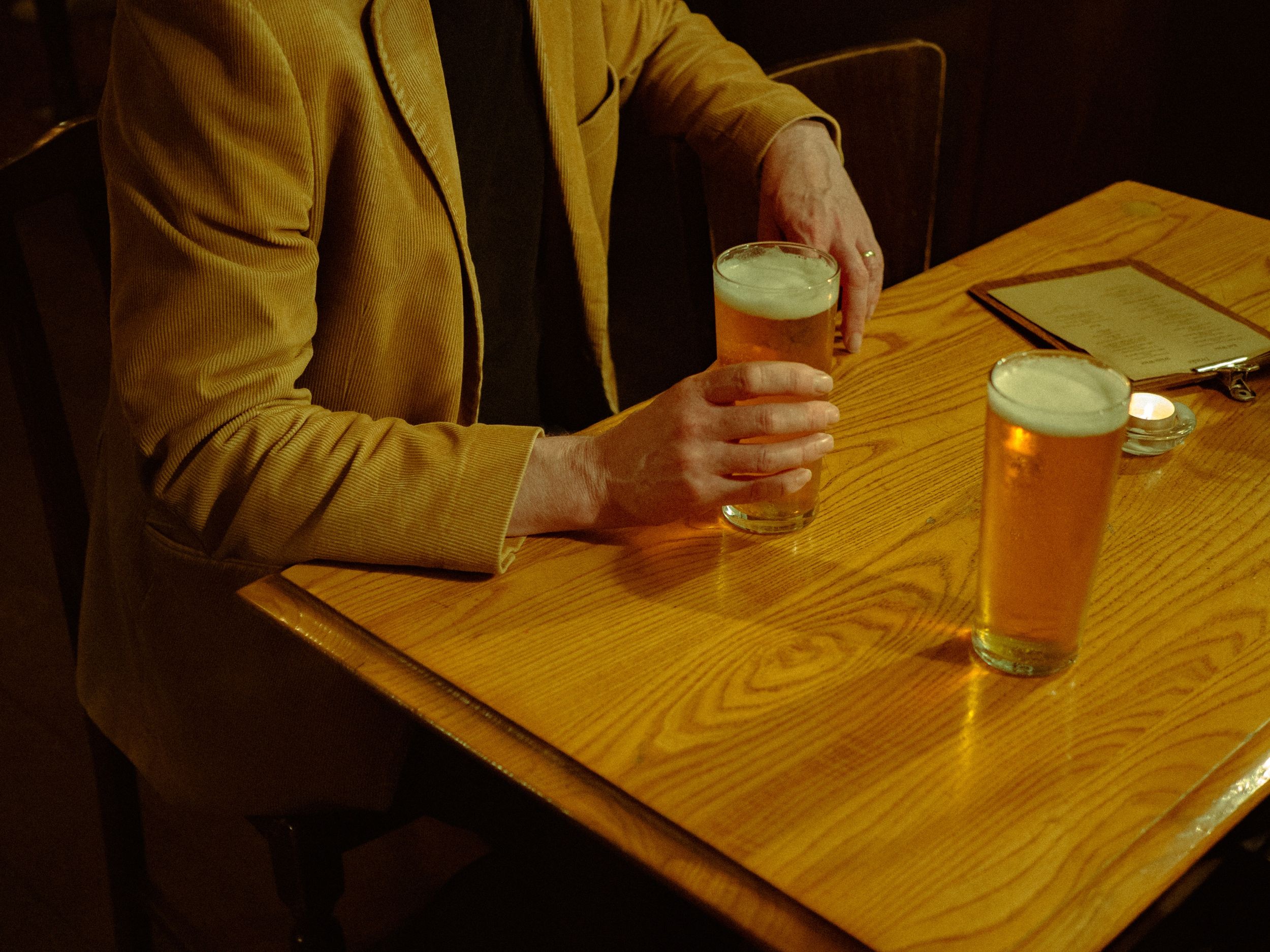
This section, if successful, will provide insight into my own unique methods of practice, in relation to an ongoing creative output of work interested in the identity & culture of my home-city, Sheffield. This output includes work produced as a freelance photographer for a variety of clients, all of which share a notable interest in the music & events industries.
My endeavour here is simple, to support myself financially through my passion of photography, whilst continuing to create work which acts as a social, cultural, and historical document of Sheffield. The following writing will highlight the various creative and production processes, as well as drafting and prototyping techniques, which I have employed in the pursuit of this goal.
Freelance Work
A crucial acknowledgement to make towards my process as a freelance photographer is that, on a large amount of shoots, drafting & prototyping beforehand is not something that I do. It is, of course, possible that this is something to reflect upon in my Production Diary. However, I believe it to be something which is a logical part of a workflow which constitutes primarily of 'DIY' music events. There is sometimes very little to do other than bring my camera & lenses, speak to the organisers for a final time, scout the lighting, and work to achieve the best possible results.
This does not, however, mean that drafting & prototyping do not make up a significant portion of my workflow. You could certainly point - as I will - to communications made between myself and the event organiser, resulting in the production of a brief. Three recent examples are shown below.
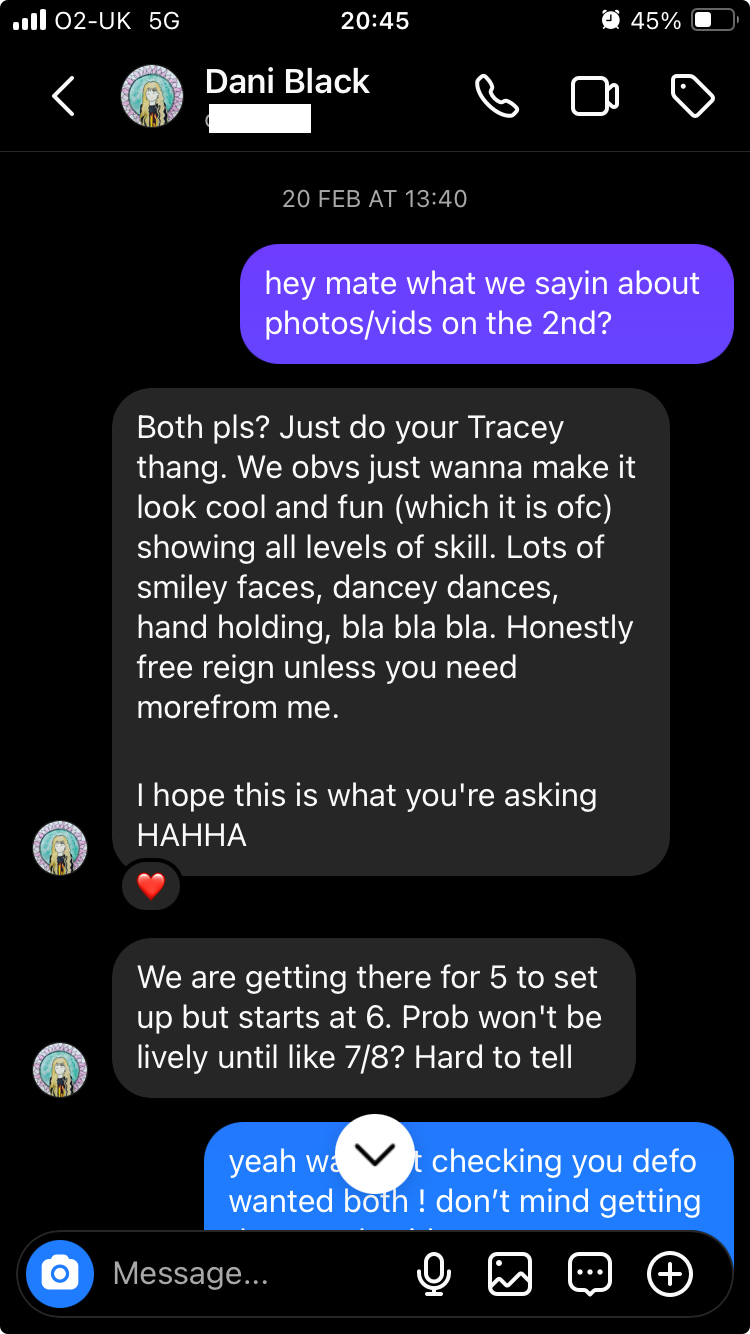
image 1A
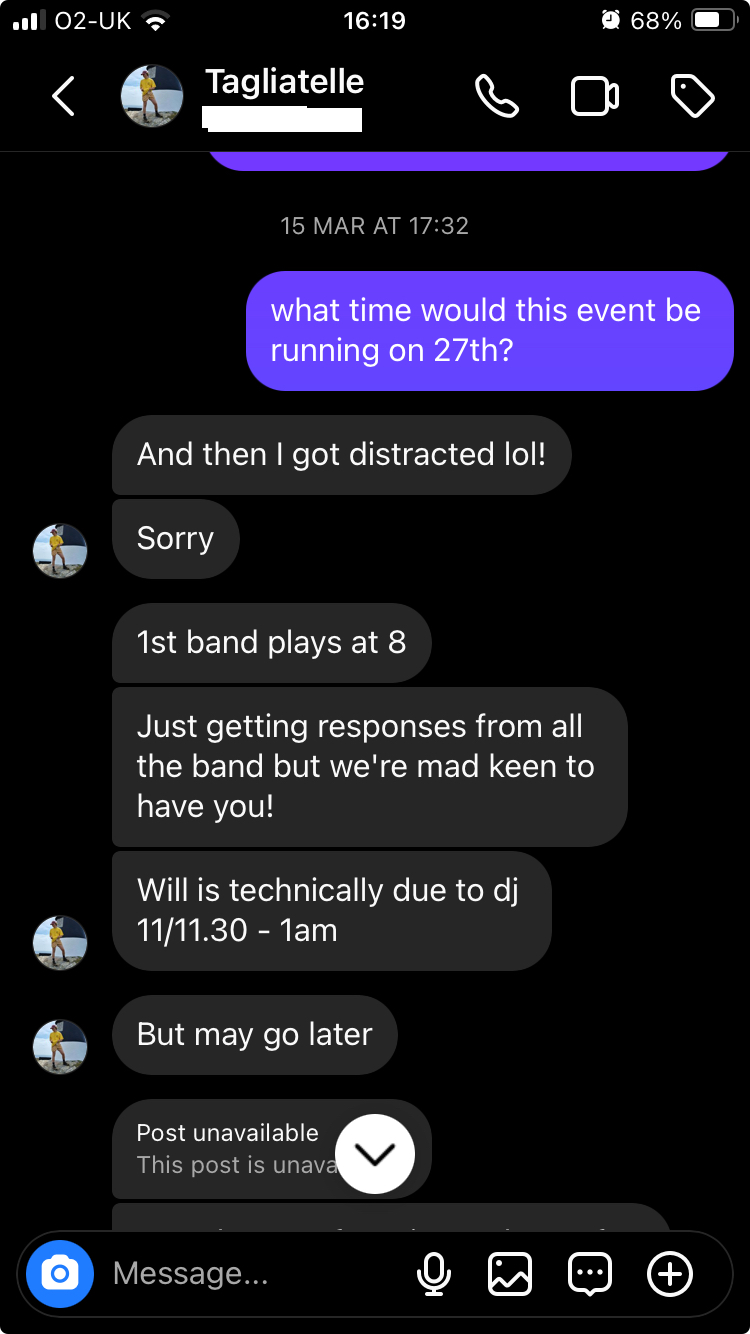
image 1b
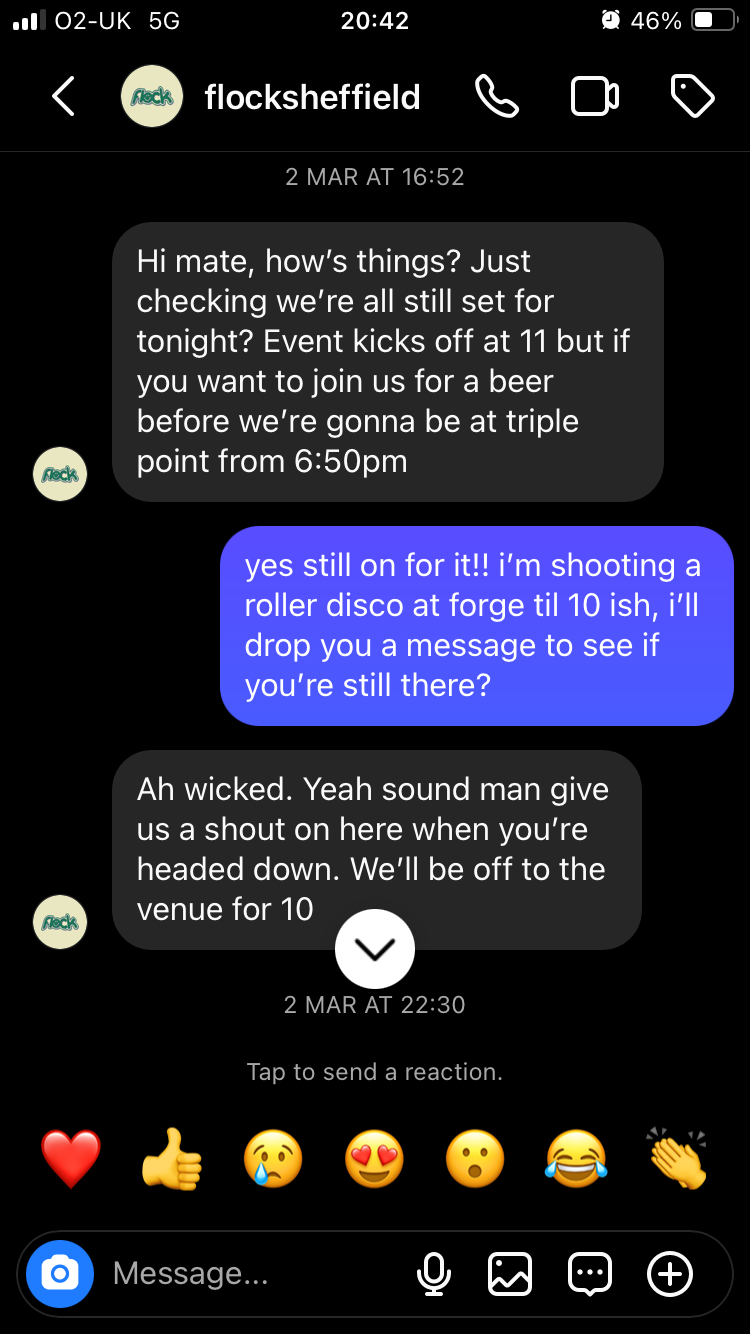
Image 1c
The briefs, however, vary in detail. Image 1a describes a "cool and fun" visual motif, consisting of "smiley faces, dancey dances, hand holding", though also suggesting "do your (Tracey) thing" and have "free reign". Image 1b describes that the "1st band starts at 8" and that "Will is technically due to dj 11/11:30 - 1am" but provides no other information, with Image 1c providing the starting time of 11PM with the suggestion of a "beer before". The thing each of these briefs have in common is a remarkably relaxed approach, with issues of scheduling being prioritised over the production of creative guidelines. Even in Image 1a where some guidelines are produced, the ultimate message is "Honestly free reign".
Despite being relaxed and schedule-oriented, the briefs given are certainly examples of drafting. They represent myself and the client planning ahead in some form, towards a gallery of photographs for use on social media. However, the lack of a more direct prototype in these messages is evident; there is no mention of 'this is how it'll look' or 'this is how i want it to look' between myself and the client. At this moment in my writing, it appears as though I get a message on Instagram, pick up my camera, and jolly down to the venue to take photos. That is, of course, not the case. As such, the absence of a creative brief or prototype is something which requires attention.
I would argue that this absence of a brief is because of the production of a clear and coherent visual style in my work, which gives the client confidence in my ability to capture their event. This style is achieved both through decisions made at the time of shooting and through post-production, specifically within the editing process, a major element of my prototyping and drafting process.
Whilst developing the analysis of Images 1a, 1b, and 1c, I will show how I am able to produce a clear and coherent visual style which allows my clients to forego the need of a creative brief. This discussion will highlight how choices made the time wow shooting intersect with the final decisions that I make when editing.
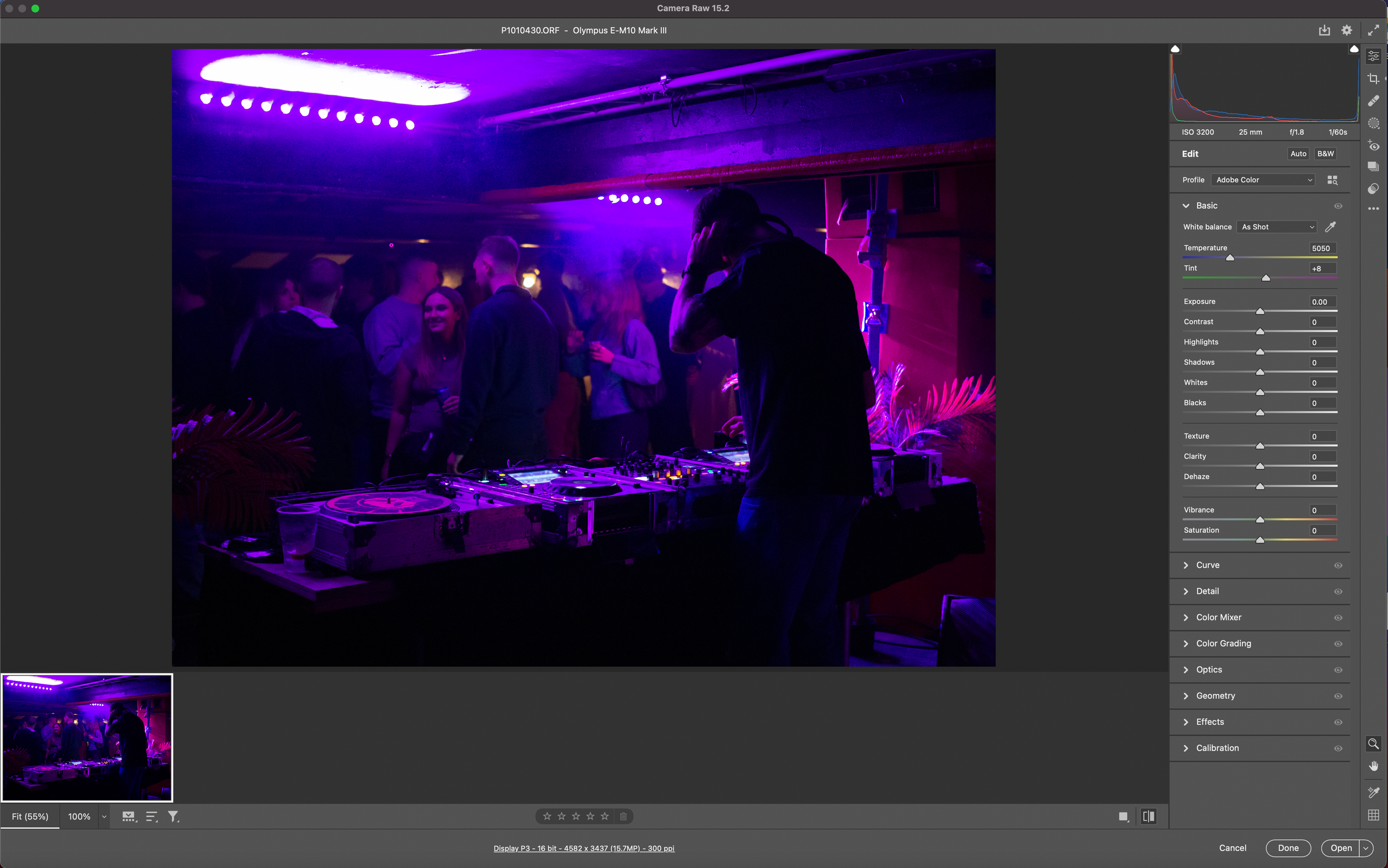
Image 2
Image 2 (above) is a photograph taken for event organisers Flock, which was briefed in Image 1c. It has been loaded into Adobe Camera Raw and appears unedited. Before engaging in analysis of my editing process, however, I would like to draw attention to the four variables at the top right of the image (also presented below)
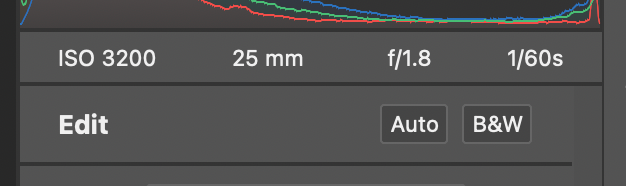
Image 3
The variables shown highlight four key decisions made at the time of shooting, which greatly impact the end product created. From left to right they are: The ISO setting, Lens, Aperture and Shutter Speed ch0sen by myself at the time of shooting. By selecting an ISO which is as high as it can be without generating Noise, choosing a lens which is able to operate at a wide aperture of f/1.8, and using a Shutter Speed which is as low as possible without generating motion blur, I am able to allow as much light into the lens as possible in a low-lit setting. This is a crucial step in my creative process, pushing my camera to the limit of its abilities in order to deliver the best possible results for the client.
These decisions are also made alongside basic principles of photography. By employing the Rule of Thirds - "a type of composition in which an image is divided evenly into thirds, both horizontally and vertically, and the subject of the image is placed at the intersection of those dividing lines" - I am able to find a composition which places the DJ on the right-third of the image, whilst also showing the crowd on the left. This creates a cohesion between the images captured, showing the DJ and crowd in the same setting and representing the intimate nature of the event. (Shown Below)
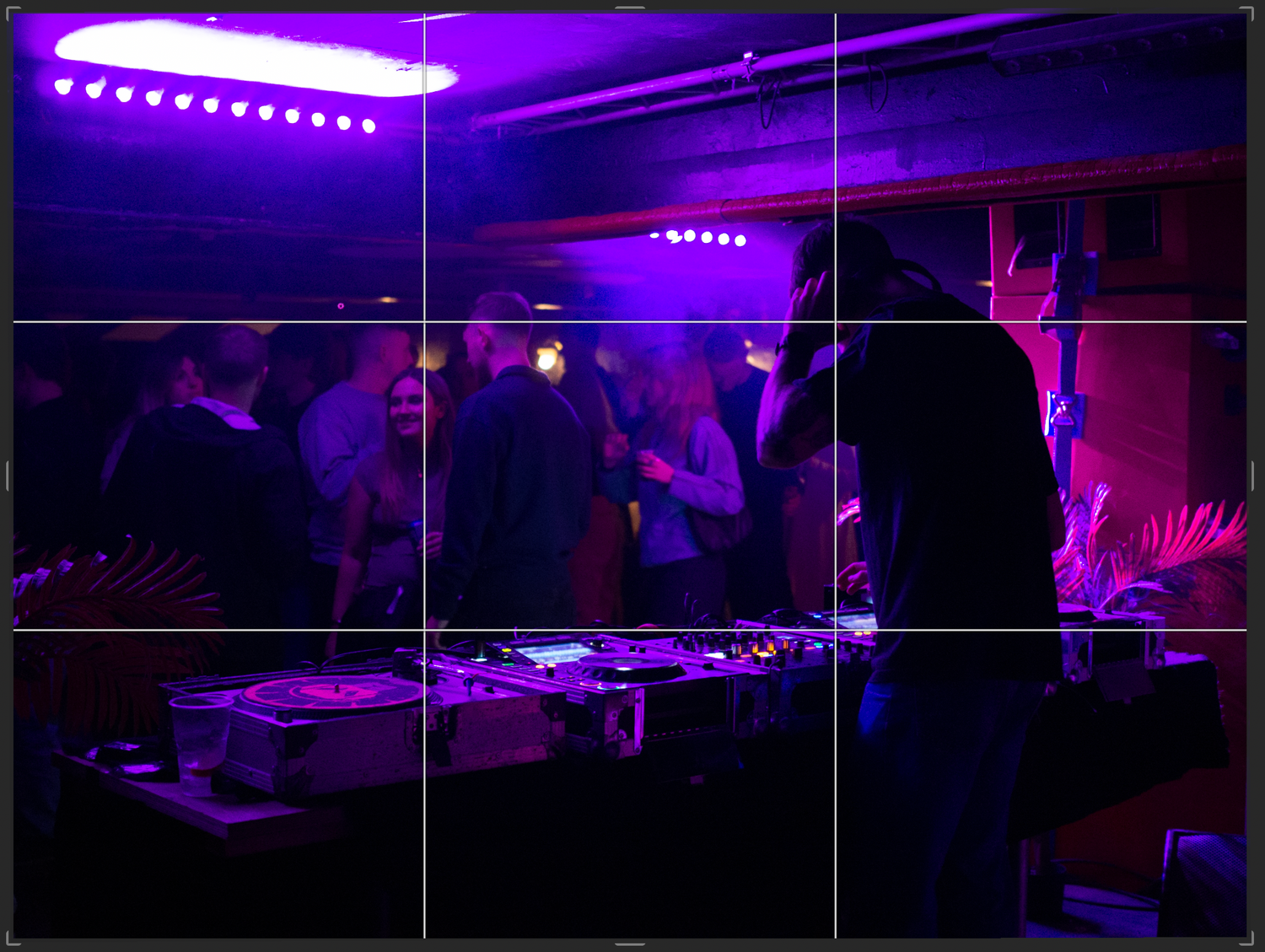
Image 4
Once these decisions have been made, and a selection of shots have been taken following the same principles, I am left with a selection of images which are framed in a way which captures the event succinctly, whilst containing as much light as possible. There is, however, still a great deal of work to be done. My next steps will focus upon corrections made to the images after they are captured, highlighting my decisions made within the editing process.
The main consideration in this process is lighting. The two purple LED strips visible in Image 4 were the only lights in the venue. With my only lighting equipment at the time being a large white LED panel, which is likely to affect the intimate nature of the event and make my presence as a photographer known - to a point by which it may impact my ability to take candid images of the crowd - I made the decision to work with what was available and make any adjustments in Post-Production. As such, my editing process in this instance focused largely upon lighting and colour corrections, as detailed below.
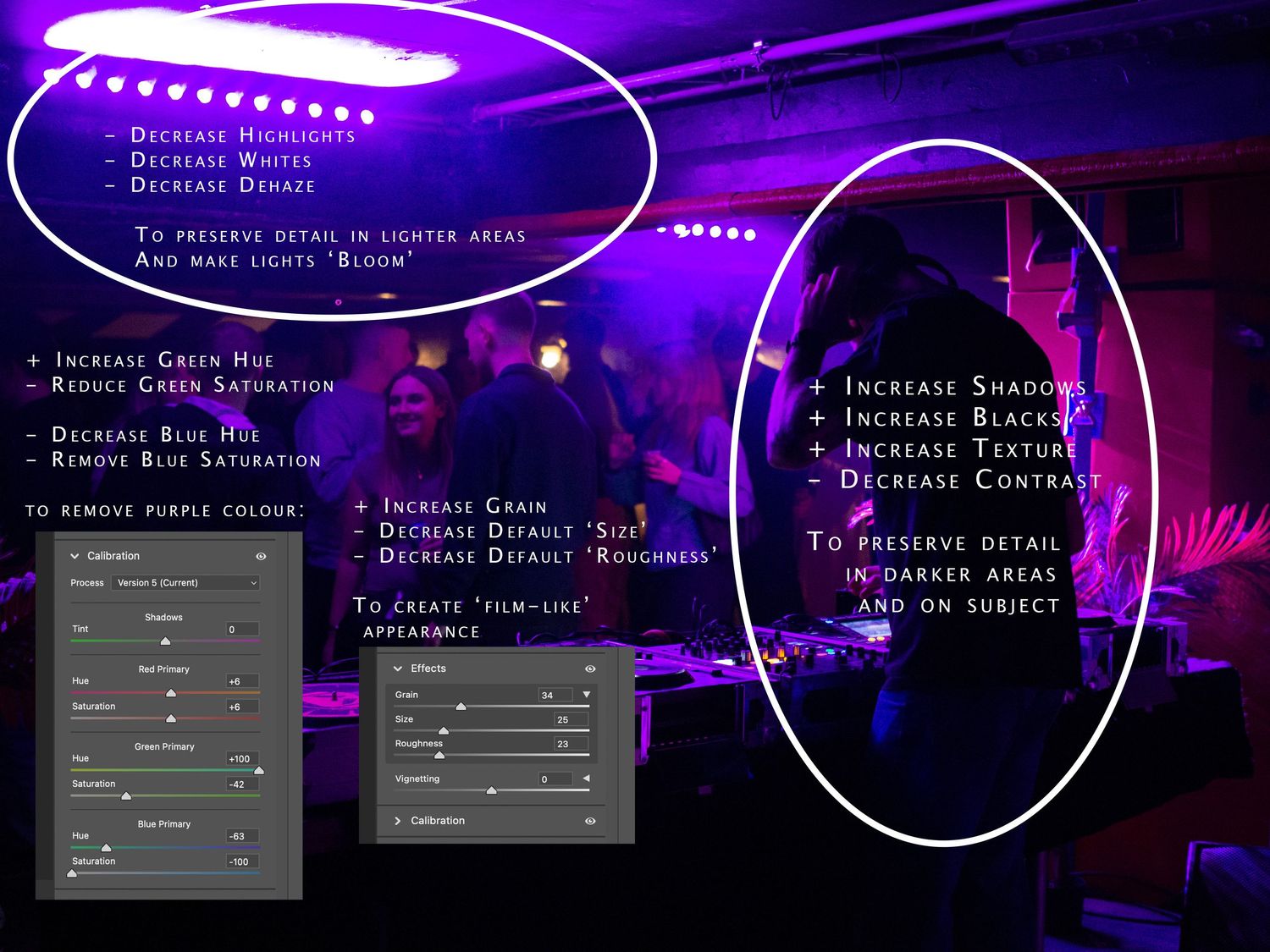
Image 5a
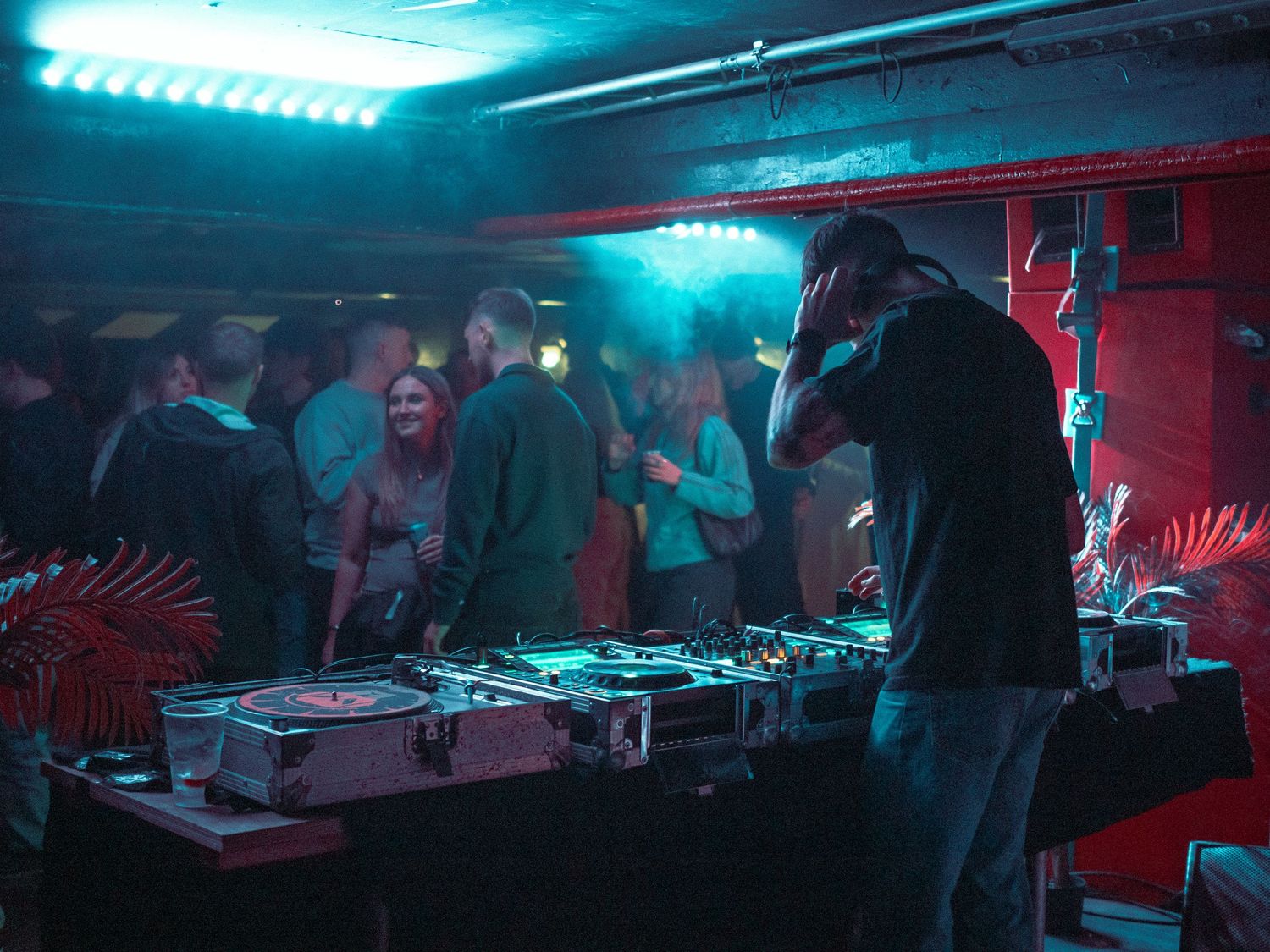
Image 5b
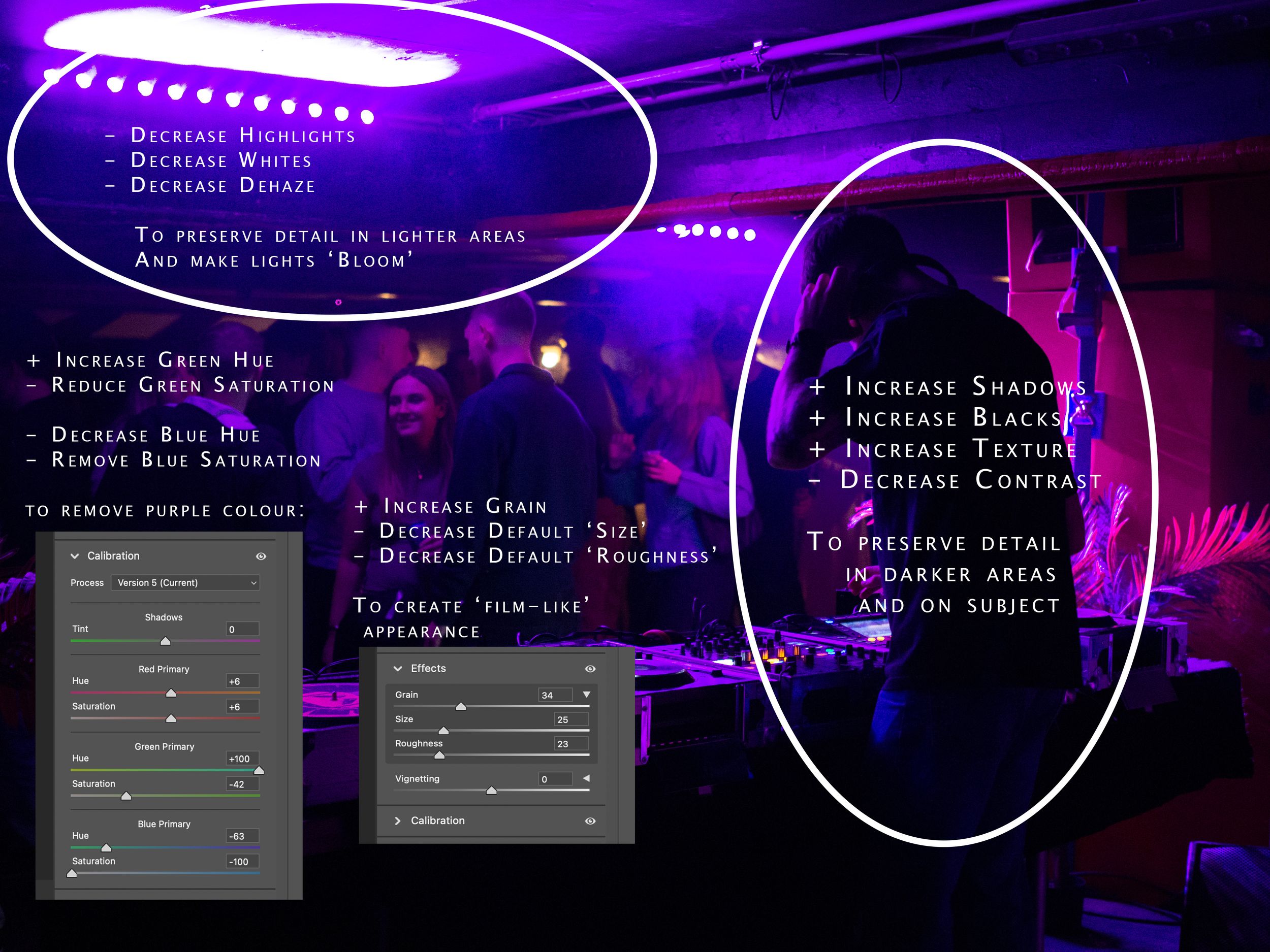
Image 5a (enlarged)
Through the editing process, I clearly alter the image in a manner which improves the final product. The most impactful of these choices, I believe, is the colour corrections. This is highlighted by the "Calibration" section in the bottom left of Image 5a. By moving my Green Primary Hue all the way to the right, and reducing my Blue Primary Saturation, I am able to create a colour palette which is restricted. This means that my greens appear more blue, whilst any 'true' blues don't appear at all. This allows for the removal of the purple tone which dominates the image, creating a teal & red colour palette which is visually pleasing and provides much-needed colour contrast.
The other decisions made are aligned with my previous decisions of ISO, aperture, and shutter speed. By allowing as much light as possible in to the image, before reducing variables of contrast & highlights and increasing blacks & shadows, I am able to generate an image with as much light and detail as possible, which is balanced and - crucially - will captivate an audience. As these images are produced for a client, who will ultimately use the images on social media to promote further events, this captivating quality is crucial. The images produced must be visually stimulating, and representative of the event being fun and enjoyable.
The execution of this core understanding is something which is reflected throughout my images (see Gallery 1) and, I believe, is what negates the necessity for a direct creative brief. Throughout my workflow, and across various clients, I consistently make decisions which result in a clear & coherent visual style. I carefully select my ISO, Lens, Aperture & Shutter Speed, consciously frame images using methods such as The Rule of Thirds, and communicate with the client to ensure a shared understanding of - at the very least - a vague schedule to follow.
By employing these techniques, I am able to produce work of consistent quality, which successfully captures a DIY music event, for use on social media. The final product of this process, a gallery detailing a music event from start to finish, can be seen below.
Gallery 2
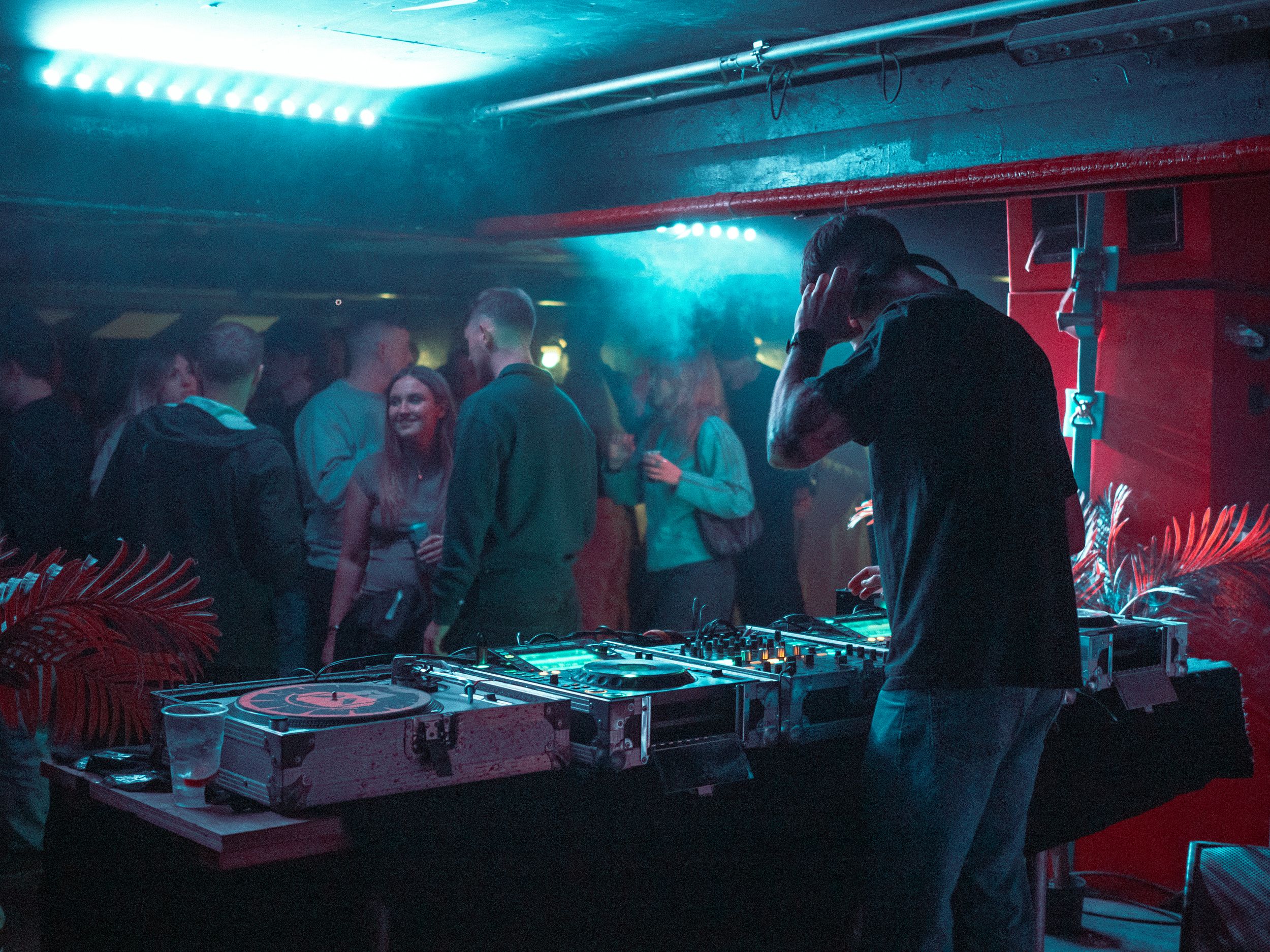
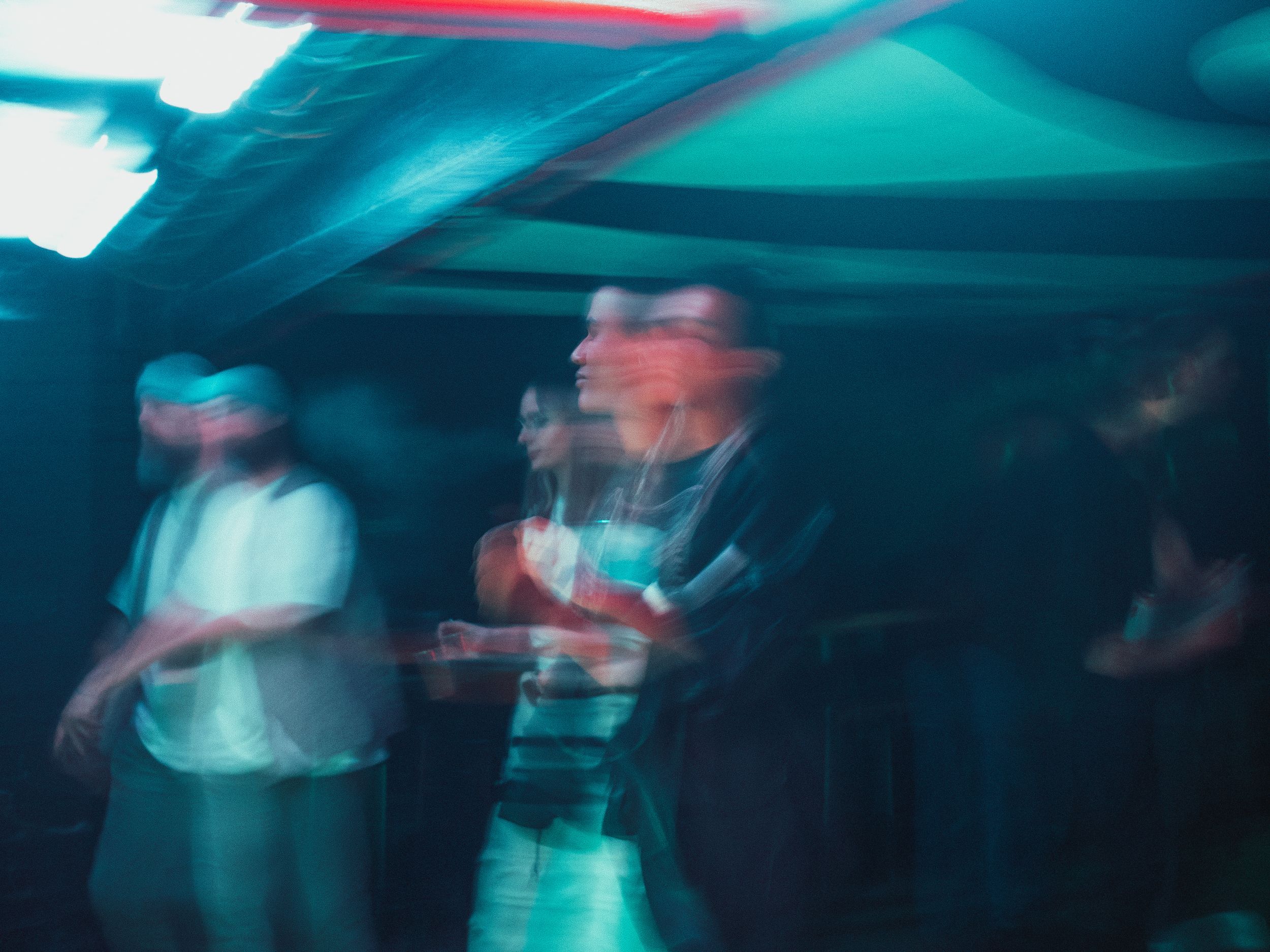

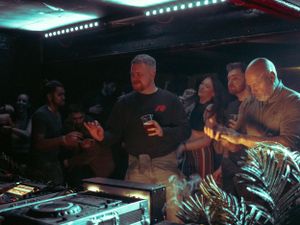
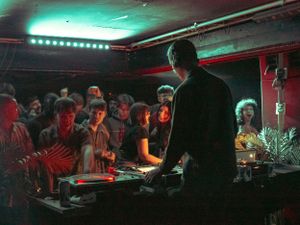
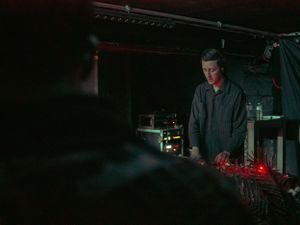
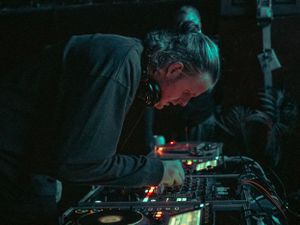
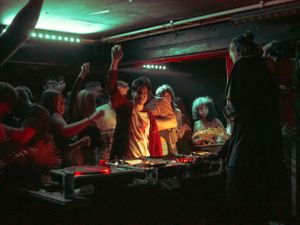
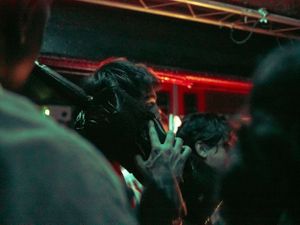
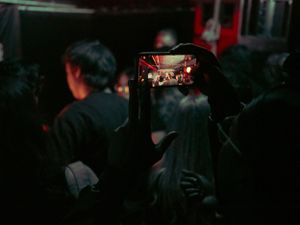
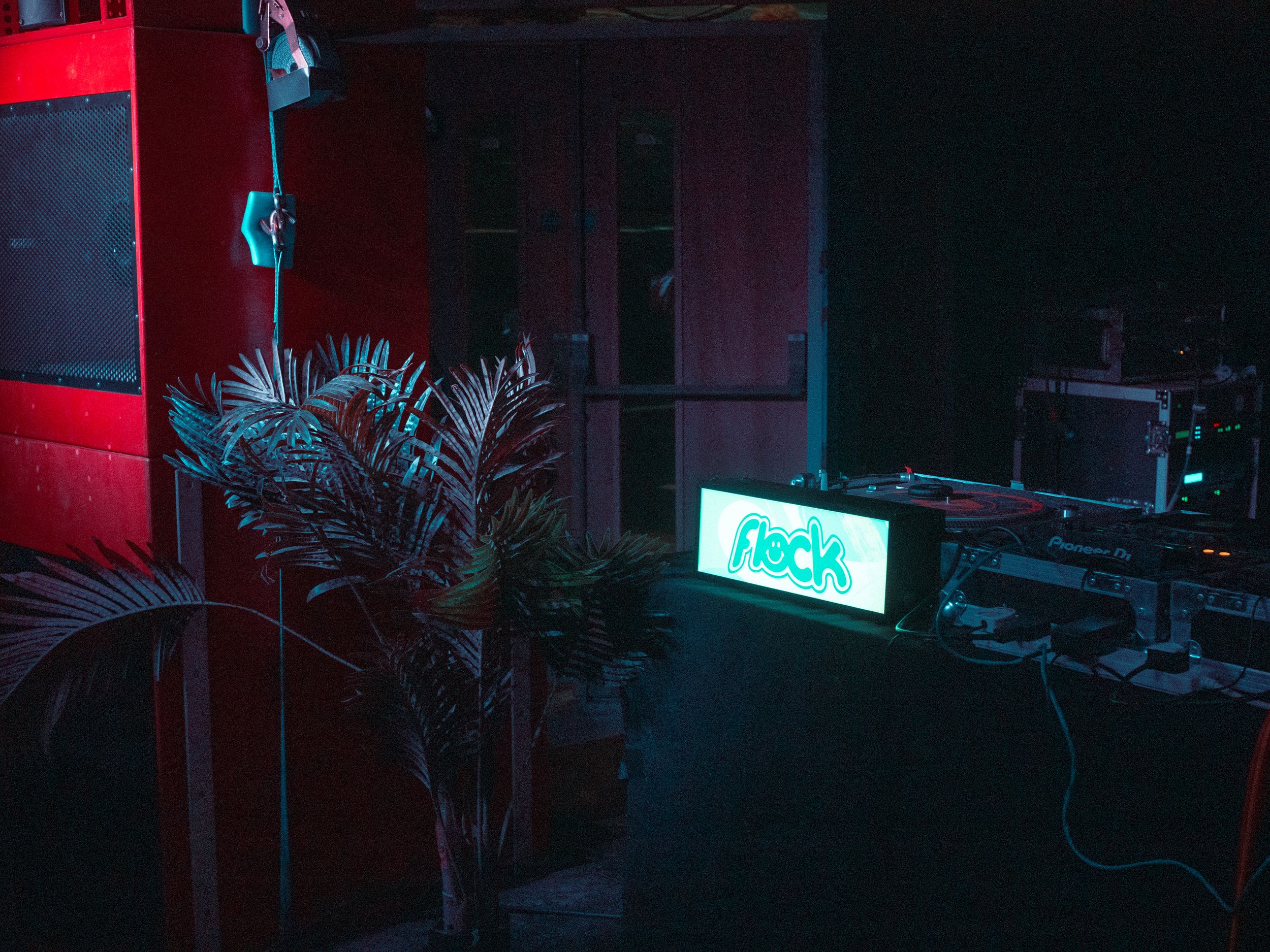
The gallery above does not exist in isolation. As shown in Gallery 1 (duplicated below) I consistently create works using the same methods of framing, choices of camera setting, and adjustments in editing. It is this factor which means a client is able to foresee how I will capture their event, and remove the need for a creative brief. By having a series of images which are of a clear visual style, and are circulated within a highly interconnected Sheffield music scene, the client has an understanding of the images that they will receive. The images produced for other events act, in their own way, as a prototype for the images that the client will receive.
Gallery 1 (Duplicated)
*Removed - See Gallery 1*
Production Diary
NOTE: The following section focuses upon an abandoned project of a film. If you would like to read my reflections upon my recent work as a freelance photographer, please scroll to the section titled "Moving Forward & Working With Others"
The following passage will present a reflection upon my processes, analysing my day-to-day experience as a creative rather than the technical aspects of production shown above. It will look closely at the sustainability of my approach, the success of my collaborations, and the relation between my work and its audience. It should, if successful, highlight key language frameworks which are proposed by the Make Happen course, evaluating my success in implementing them and their impact upon the value of my productivity as a creative.
This passage will not be dated, but will move chronologically through my experience of the past 12 weeks as a creative and indeed as a Make Happen student. Perhaps a good place to begin reflection here is that I have not kept a thorough diary, and this process would be significantly easier if I had. One phrase which is written within the journal I have kept, is one that Make Happen Course-Leader Tom suggested in a "Huddle" (30 minute meetings held between Course Leaders, Coaches and Students each Monday and Wednesday) : "You won't get anything out of this if you lie".
It is perhaps an ironic hypothesis to make, but I believe this section will be successful if I actively engage with the avoidant nature of some of my decision making over the past twelve weeks, alongside (of course) the successes that I have made. It is also important to recognise that, whilst I have been able to identify avoidant behaviour patterns as of late, it is likely a product of thinking within the frameworks provided by the course.
What better place to start, then, than with a reflection upon the project which I declared I would develop through the first module of this course, before reaching the conclusion - through the language frameworks provided - that it was in my best interest to move on.
An ambitious reimagining of the Pirate genre, "Scurvy" has all the makings of a BlockBuster epic. But, like many eagerly anticipated spectacles of filmmaking, it fell short at the pre-production phase. Without an overbearing producer, unruly cast-member, or visionless director to blame (I was, sadly, the only person involved in the production), any hope of learning from this experience relies upon the exercise of introspection.
Declarations & The Next Thing
This writing, honestly, feels quite difficult. I joined the Make Happen course with an ambition, to develop my practice from that of a photographer into a filmmaker. Through the Make happen course, and the language frameworks provided, this ambition became a Declaration. Simply put, a Declaration is a clear, concise and measurable statement which states your creative project. In the context of the Masters course, this declaration is one which will be achieved in the space of a year.
A crucial part of the Make Happen frameworks is clarity. A vague Declaration will result in a vague creative path and few opportunities for measurable achievement. So, when my time to make a Declaration came, I stood, in Sweden, on the first of three residential workshops in the Make Happen course, in a room surrounded by peers, and declared that "I will create my Pirate Film by the end of the year". It felt amazing, almost electrifying. My wildest ambition, to create a large-scale, moody, and character-driven tale of a fleet of pirates slowly succumbing to scurvy, was underway in an instant. All that there was to do, the only thing, was "The Next Thing".
"The Next Thing" is another framework promoted within the Make Happen course. It is one which I found great comfort in, and continue to do so. Rather than balance a muddled amalgamation of hundreds of things that must be done in order to get where I want to be, I can instead focus on "The Next Thing" to do. The thing that is the natural next step, which will move my project forwards no matter how big or small.
There was a specific moment in Sweden where I felt the freedom of this concept greatly. Smoking a cigarette, alone, outside, and in the cold, in a moment which I would usually spend balancing (what felt like) a thousand things in my mind, I told myself 'there is only The Next Thing'. No 'what should I do about this client?', no 'how on Earth is this film going to happen?'. Only The Next Thing. It is crucial to note that this "Next Thing" may exist on various scales, and works alongside the course's suggestion that you set "One Thing" to do every day, which is a measurable and achievable task, which will support you and your endeavours.
My "Next Thing" in Sweden was the production of a script for my film. My "Next Thing" on that process could be simply turning on my computer to begin writing, it could be creating a plan for each scene, or it could be completing a first draft of the script. Upon reflection, as intend to do in the passage below, my lack of focus upon a small, simple, and measurable "Next Thing" throughout the process is likely something which contributed to me struggling to move forwards with the project.
That, for me, was the production of a script. It was in this stage where I realised, 'perhaps this isn't as easy as just knowing the frameworks'.
Being Stuck in the Having Done
I arrived home with one Next Thing to do towards my project: the production of a script for my film. As a result, when we set one "Next Thing" to do for our upcoming Sprint (A four-week period in which you set an achievable goal which will have great impact upon your project), I declared that I would write a first draft of my script in a four-week window. Looking back, that declaration seems absolutely preposterous, and my reaction - to become avoidant of the insurmountable task I had given myself - makes a lot of sense.
In subsequent Huddles, for consecutive weeks on the program, I would set my "One Thing" for the day as writing 'X' amount of pages of my script. The amount of pages varied greatly, depending largely upon how guilty I felt that I had written none the previous week. "Today I'm going to write five pages of my script, because I didn't get any done last week" I would say, knowing that the task wouldn't be completed, before turning around and going back to sleep. Then the next week would arrive. "Today, I'm going to write one page of my script, because I said I'd do five last week and I didn't do any". The cycle would go on, and on.
Upon reflection, I had set a mammoth task. To complete a script in such a short amount of time was unfeasible. To counteract this, I would create over-ambitious goals for the amount of writing that I would do, before consistently falling short of those targets as well. I was, unintentionally, creating a cycle of guilt for myself. Consistently missing goals, becoming disengaged with the Masters program and the choices that I made, all whilst - as days and weeks passed- my mammoth task grew bigger. I was stuck.
By creating a monumental task, and holding myself to finish it despite missing goals in the Sprint, I was "Stuck in the Having Done". I was consistently looking at the end-point, the production of a cohesive draft of my film, and not engaging with the Compounding Process (whereby a large task is separated into "Next Things" within your "Sprint", to help you achieve your goal one step at a time).
A Lack of Collaboration
Change was needed, and I made it, but there remains something to reflect on within this process. Despite seeing myself as somebody who is outgoing, is able to accept help, and works well with peers, I did not at any point engage with the idea of somebody else writing the script. Film is, after all, a collaborative medium, yet I chose (consciously or unconsciously) to remain sat in my bedroom, looking at a painfully similar script to last week, without ever reaching out to a writer. One of the main takeaways of the course is to live in "possibility" - to consider that any number of things are possible, and that you have the ability to make them happen - yet I decided that nobody would be interested in writing my script.
That is, upon reflection, a major variable which could have resulted in the progression of the project. The reality is that, whilst also setting unrealistic expectations of myself, I found the writing process isolating. Conversely, I loved the idea of taking photographs, creating images on a frequent basis would be exciting, fulfilling, and constantly engaging. It is ironic, then, that the editing process for photography is similarly isolating, sometimes feels as big a task as a script, and takes place at the same computer.
Allowing Polarity
With the above observation - a stark polarity between my ideas of writing a script and taking photographs - I can begin to describe how I was able to move on from an unsuccessful project. The above section has, admittedly, been much longer than I intended. There may even be a sense that it feels separate from the Prototype section which precedes it. That is, however, close to the reality of the situation. I had been stuck on my script for so long that to write any reflection of my work as a creative, without reflection upon the amount of time I felt Stuck writing a script, would be no meaningful reflection at all.
It is the process of "Allowing Polarity" (accepting that two counterintuitive truths can be true at the same time) which allowed me to move on. It is, in fact, a key moment in my journal - an 'aha moment' if you will. As it was written on 28/02/24, "I haven't been allowing myself not to make the pirate film!" (Image 6). What followed - and what existed in between the polarity of wanting to/not wanting to make a pirate film - was the freedom to reset my declaration, and pursue other creative endeavours.
(Image 6)
Moving Forwards & Working With Others
Moving forwards, I had the possibility to apply the language frameworks that I had learned through the Make Happen course to a new declaration, that "I will become financially independent through my work as a freelance photographer". This pursuit, in the month following the abandonment of my previous project, has so far been successful. The analysis of this supposed success, and reflection upon its sustainability, will highlight the importance of clear communication, scheduling, and understanding of audience response, whilst evaluating the sustainability of my practice going forwards.
(Images 7a & 7b)
The images above (Image 7a & 7b) show my 'work schedule', a list of all previous/upcoming work alongside the agreed payment. It represents, in one sense, me having some form of clarity over my schedule and finances. I can see clearly that in the month of March I have taken £1470* of revenue in my pursuit of financial independence. I have also been able to schedule my time somewhat effectively, knowing which days I have free and which days I have shoots.
This method is, however, flawed - and has resulted in me being confused about dates on more than one occasion. Whilst it is true that I have gained some clarity of scheduling and finance compared to before the Make Happen course, it is also true that the success of both my scheduling and tracking of finances could be greatly improved with the use of more relevant software.
What Image 7a also shows is work which I had considered to be confirmed, and so financially accounted for, which fell apart at a later date. The two images below (8a and 8b) show the communications that I received from the organisers of each event, followed by a reflection upon the sustainability of my practice as a freelance events photographer.
*It is worth noting that £250 of the revenue ("Peddler" and "Barrowboy") is received from bar shifts.
(Image 8a & 8b)
Both images bring the topic of sustainability as a freelance events photographer into immediate question. Image 8a raises the issue of budget, with the organiser stating that they have "had to shop around and take the cheapest option" and that "Friday is set to lose a tonne". The event in question was hosted at one of Sheffield's largest venues, with two recognisable headline bookings. It looks, from the outside, to be one of Sheffield's most profitable events, yet they are operating at a loss and supposedly unable to pay what was an exceptionally low quote. Image 8b is presented in a more hopeful tone, though still shows clearly the competitive nature of freelance photography. The suggestion that "I've gone with (------) who we normally use" is not a particularly consoling one to receive.
Is the best method to persist? Should I fight through the challenge, gaining clients through a portfolio of inarguable quality? That suggestion seems like it may be another insurmountable task. Indeed, I have been able to earn a liveable income in March, but there is a clear issue of budget constraint, as well as competition with other photographers.
As discovered through the process of "Allowing Polarity", the truth likely exists somewhere in the middle - there will be challenges faced, but there is still more that I can do. What is important to note is that I do, certainly, have recurring clients who other photographers would like to shoot for. A focus, then, on what allows these relationships to form - and the work needed to maintain them - should be a good opportunity for reflection.
Consistent Clients
The business "Wood Tools" (Listed as Rob in Image 7a) have become a valuable client as of late. Producers of Sheffield-Made Axes & Knives, they exist outside of the hospitality & events industry whilst also working within my interests of Sheffield culture, history, and documentary. Our current agreement, to work together every other Tuesday, is one which provides much needed financial stability as a freelance photographer.
As a client, they pose an audience which is markedly different from my usual experience. An important distinction to make here is that, in the context of freelance work, your client is an audience. They receive the work with certain expectations, and will judge its success based upon them. They also, of course, have their own audience - in this context the followers of the account "WoodTools" on Instagram. Therefore, I must produce work which satisfies the client's needs, as well as satisfying their own perceived audience.
As such, the production of work in a timely manner, with clear communication, and of justifiable quality, is crucial. Examples of the work, which document the activities of the 'Wood Tools Workshop', are below, along with a final evaluation of the success & sustainability of my approach.
Gallery 3
*Moved - See "WoodTools" Gallery on Portfolio page*
Final Reflections
Some things became extremely clear in the process of writing this reflection. One of them (see Image 9) is that my organisation of photographs is appalling, to an extent which it has become difficult to find images in a timely manner. I have several duplicated files, several folders with no clear structure, and even images which have been automatically removed by my computer in its quest to find storage space.
I mentioned in early sections of this Production Diary that any successful reflection would "actively engage with the avoidant nature of some of my decision making". It has become clear to me through the process of creating this document that such behaviour is not limited to my avoidance of writing a script. The revelation of the poor organisation of my files, for a client which my analysis had highlighted as "valuable", is sobering to say the least.
My action upon this fact will be firstly to allow that it has happened, before being thankful that I have previously uploaded all images to the client's own archive, and move forwards by buying a storage device to be used for all future client work.
This process of writing has also revealed that I have been avoidant of the assessment itself. Whilst I have gained success in my endeavour, and have made use of the frameworks provided by the course, this writing would certainly have benefited from more time to draft, redraft, and share with peers. It has, subsequently, reflected a great deal upon my previously abandoned project, without offering great insight into my current work as a freelance photographer. If I had made better use of the time I had available, this Production Diary would have reflected upon the work and processes analysed in the Prototype section.
It must be said, however, that my efficiency as a freelance photographer has greatly improved thanks to the frameworks provided by the Make Happen course. The communications that I have made with clients have been far clearer, I have worked to return images on a consistently concise time-frame, and I have had more success in the past month as a freelance photographer than in any month beforehand.
References
Images:
1a: Screenshot: Instagram messages to/from clients (2024)
1b: Screenshot: Instagram messages to/from clients (2024)
1c: Screenshot: Instagram messages to/from clients (2024)
2: Screenshot: DJ and Crowd in Adobe Camera Raw (2024)
3: Screenshot: Closeup of camera settings in Adobe Camera Raw (2024)
4: Merritt, Cameron: DJ and Crowd, With Rule of Thirds grid overlaid (2024)
5a: Merritt, Cameron: DJ and Crowd, unedited with annotation (2024)
5b: Merritt, Cameron: DJ and Crowd, edited (2024)
6: Merritt, Cameron: Photograph of Journal (2024)
7a: Screenshot: Schedule kept in 'notes' app (2024)
7b: Screenshot: Schedule kept in 'notes' app (2024)
8a: Screenshot: WhatsApp messages to/from clients (2024)
8b: Screenshot: Instagram messages to/from clients (2024)
Galleries:
1: Merritt, Cameron: Selection of images from various clients (2024)
2: Merritt, Cameron: Images taken for Flock (2024)
3: Merritt, Cameron: Images taken for Wood Tools (2024)
Citations:
1: Rule of Thirds definition (https://www.slrlounge.com/glossary/rule-of-thirds-definition/) SLR Lounge, Undated (Accessed 2024)
2: Huddle (30 minute meetings held between Course Leaders, Coaches and Students each Monday and Wednesday) Make Happen Institute, 2024
3: Declaration (a clear, concise and measurable statement which states your creative project) Make Happen Institute, 2024
4: The Next Thing (the next thing you can do which will progress your creative project) Make Happen Institute, 2024
5: Sprint (A four-week period in which you set an achievable goal which will have great impact upon your project) Make Happen Institute, 2024
6: Stuck in the Having Done (Focussing upon the end-point rather than the process) Make Happen Institute, 2024
7: Compounding (separating a large task into small steps) Make Happen Institute, 2024
8: Possibility (the infinite amount of things which are able to happen at any given time) Make Happen Institute, 2024
9: Allowing Polarity (accepting that two counterintuitive truths can be true at the same time) Make Happen Institute, 2024